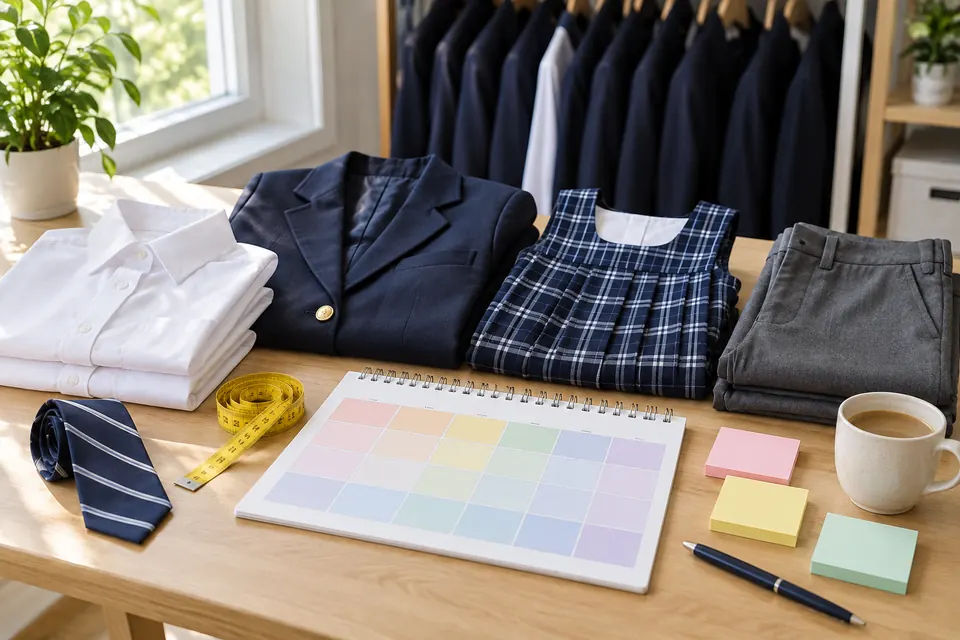
The most accurate way to size staff for uniforms is to combine try-on size sets for standard garments with professional measurements for tailored items, and to record every result against each employee's name, ID and department. Run sizing by department so operations are not disrupted, plan a follow-up session for anyone absent, and keep a small buffer of common sizes for exchanges and new joiners.
Sizing is where most uniform rollouts go wrong. Wrong sizes lead to exchanges, delays, staff who look untidy and garments that sit unused in a cupboard. The good news is that a little planning prevents most of it. This guide explains the three ways to collect sizes, how to run a sizing day, what to record and how to handle the people who are always missed.
Three ways to collect sizes
| Method | How it works | Accuracy | Best for |
|---|---|---|---|
| Self-reported size list | Staff tell HR their usual size | Lowest; sizes vary between brands and cuts | Simple T-shirts, event wear, small top-ups |
| Try-on size sets | Staff try sample garments in each size and choose the best fit | High for ready-size garments | Shirts, polos, scrubs, tunics, trousers, workwear |
| Professional measurement | A trained measurer takes body measurements | Highest for fitted garments | Suits, blazers, waistcoats, front-office and made-to-measure uniforms |
Self-reported sizes are fast but unreliable, because a medium in one brand can be a large in another, and people often guess. Try-on sets solve this for most garments, because staff choose the size that fits in the actual garment they will wear. Professional measurement is worth it for tailored items, where a small error is very visible. Our design and tailoring service includes on-site measurement sessions and made-to-measure production.
Planning the sizing session
Before the day
- Get a complete staff list from HR with names, employee IDs, departments, roles and shift patterns.
- Confirm which garments each role will receive, so staff only try what they need.
- Agree a schedule by department and shift, so each team is away from work for as short a time as possible.
- Book a private space with mirrors, and separate areas or same-gender measurers where staff prefer it.
- Ask the supplier to bring a full run of sizes in each garment and style, including men's and women's cuts.
On the day
- Check each person in against the staff list.
- Let staff try garments over light clothing, as they would wear them at work.
- Check fit by movement, not just standing still: reaching, bending, sitting and lifting.
- Record the chosen size for each garment, plus any alterations such as sleeve or trouser length.
- Note anyone who is absent, on leave or on a different shift.
After the day
- Share the completed size list with department heads to check for gaps.
- Run a short follow-up session, or leave size sets with HR, for anyone missed.
- Confirm final quantities by size with your supplier before production.
What to check when staff try garments
- Shirts and blouses: buttons sit flat without pulling, shoulders sit at the shoulder point, sleeves reach the wrist or the agreed length
- Trousers and skirts: comfortable at the waist when seated, correct length with work shoes on
- Tunics and scrubs: enough room to bend and reach without riding up
- Chef coats and workwear: room to move freely, sleeves clear of hot surfaces and machinery
- Jackets and blazers: close comfortably, with room for a shirt underneath
Encourage staff to choose the size that fits when they move, not the size they think they are. For roles with heavy physical work, a slightly relaxed fit is often more comfortable in heat.
What to record for each employee
A clear record is the foundation of accurate packing and easy reorders. For each person, record:
- Name and employee ID
- Department, role and site or branch
- Garment, style and cut for each item
- Size chosen for each item
- Any alterations, such as trouser or sleeve length
- Name for embroidery, if names are added, spelled exactly as it should appear
- Quantity of each item
Spelling mistakes in embroidered names are a common and avoidable problem. Ask each employee to confirm how their name should appear before the list is finalised.
Packing and distribution
Ask your supplier to pack each person's uniform together, labelled with their name and department. It turns distribution into a simple hand-out rather than a sorting exercise, and makes it obvious if anything is missing. For multi-site organisations, ask for packing by site or branch first, then by person.
Exchanges, new joiners and reorders
Even with good sizing, some exchanges are inevitable, especially after staff wear and wash garments for the first time. Agree the exchange process with your supplier before delivery, and keep a small buffer of the most common sizes so new joiners and urgent exchanges do not wait for a reorder.
Keep the size records up to date as staff change roles or sizes. If your supplier records sizes by employee, the next reorder can start from that list instead of from scratch.
Common sizing mistakes to avoid
- Ordering from last year's list without checking it against current staff
- Using one size chart for different garments, cuts or fabrics
- Letting staff try garments over heavy clothing, or not at all
- Forgetting staff on night shifts, leave or other sites
- Finalising quantities before department heads have checked the list
- Ordering exactly to the size list with no buffer for exchanges and new joiners
- Collecting names for embroidery without checking spelling with each employee
Measuring staff in Ras Al Khaimah and across the UAE
For teams in Ras Al Khaimah, staff can also visit our showroom to try sizes and see fabrics. For teams elsewhere in the UAE, our specialists run measurement sessions at your premises, working through staff department by department. Learn more about our Ras Al Khaimah showroom.
Quick answers
What is the best way to collect uniform sizes from staff?
Try-on size sets for ready-size garments such as shirts, polos, scrubs and workwear, and professional measurement for tailored items such as suits and blazers. Avoid relying only on sizes staff report themselves.
How do you handle staff who miss the sizing day?
Run a short follow-up session or leave size sets with HR so they can try sizes between shifts, and do not finalise quantities until everyone is covered.
What should be recorded during a uniform sizing session?
Name, employee ID, department, role, site, the size of each garment, any alterations, the name for embroidery and the quantity of each item.
How many spare sizes should we keep?
Keep a small buffer of the most common sizes in each garment, enough to cover new joiners and urgent exchanges until the next reorder. Your size records will show which sizes are most common.
Planning a rollout? Send us your staff numbers, roles and sites through our contact page, and we will propose a sizing plan with size sets or an on-site measurement session at your premises.